Movement, confidence, and the developing child
Why physical activity is fundamental to children’s thinking, growth, and sense of self
| October 2026I was very lucky to be trained by a nursery teacher who knew everything about the garden and outdoor play. I’m Dr Helen Bilton, Professor of Outdoor Play and Learning, and the outdoor teaching and learning environment has been my lifelong passion. I have researched, written and presented about the subject of outdoor play across the world.
Child development has generally been squeezed out of training courses, and to fill the void, I have written a series of books under the title of Bringing Outdoor Play to Life. The first to be published was on the subject of physical development. Here I share some considerations of this aspect of child development.

The body and mind are linked
The body is the most amazing example of high-speed communication. Just consider when you drop something and then catch it before it hits the ground. Think about all the communicating that has gone on. The brain registering that there is an issue, the brain working out movement that is needed, the brain telling bits of the body to move, the relevant parts of the body carrying this out, and then the body telling the brain the thing was caught. And that is the simple version!
Physical development is not an add-on, and certainly not the least important aspect of child development. However, it is often the least understood.
Educator Jean Piaget saw physical development as the pre-requisite to intellectual development. Thought, he argued, is internalised action. And through movement the progress of the child’s development is measured. One way to understand physical development better is to see it as the window to view and understand the whole child.

A child should move from dependency and helplessness to independence and strength and from involuntary and reflexive movement to automatic performance. This is true for any child. Daniel, who is featured in Physical Development and Outdoor Learning: A Practical Guide for the Early Years has dyskinetic cerebral palsy, but he has every right to be an independent and automative in movement as far as is possible for him.
Wise guidance, thoughtful interaction, careful planning
The adults around the child are crucial in helping children develop their true potential. They need to watch children move. Do you have children who:
- use pencils with too much pressure, so that they almost go through the table,
- reverse letters
- don’t know left from right
- run their fingers along the coats in the corridor
- play roughly with other children or bump into things?
There is nothing bad about these children, but they may have proprioceptive dysfunction. Unfortunately, because of these behaviours, often these children can be labelled as bad or problematic. Yet they are neither of these. They have proprioceptors which are not functioning as well as they could. Proprioception is about knowing where we – or the parts of our body – are without needing to look. If we had to look at our feet the entire time we were walking, we wouldn’t get very far. However, some children don’t have such awareness, leading to issues with balance, coordination and motor control.

If a child is struggling with proprioception, adults need to help the child understand their body. These children need lots of stimulus through the senses in the hands, feet, and body to learn about their body in space. Through being able to move and feel the whole body, the brain becomes more aware of the body in space and as a result, balance, coordination and motor control improve.
Helping these children can be done through outdoor play, and through helping them to weight-bear. For example, this might include:
- pulling a truck full of other children, or blocks,
- carrying a heavy log,
- going upside down on the monkey bars,
- pulling on a rope attached to a post or tree,
- jumping from side to side over a log/bench,
- building complex structures with blocks, which involves fetching and carrying and rearranging the blocks.

With good body movement comes personal self-worth
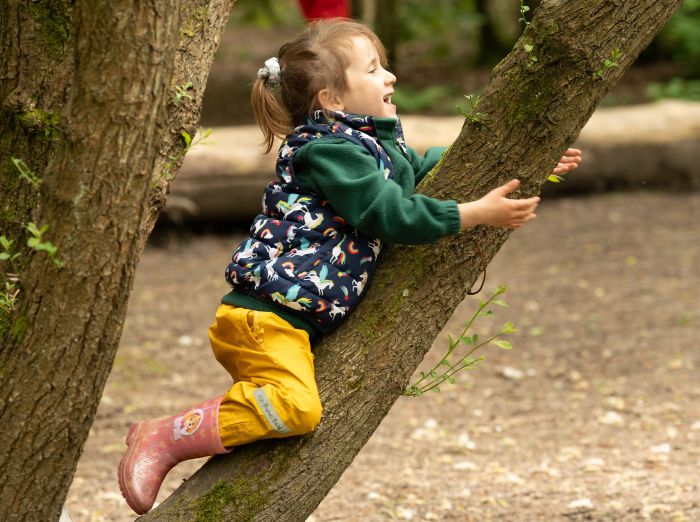
Children need to love themselves and feel self-worth to grow up to have a strong sense of self as an adult. The value judgements a child makes about themselves is defined as the discrepancy between what they can do, and what the child thinks they should be able to do. By being physically able, a child can grow a sense of self-worth. Do you remember learning to ride a bike, climbing a tree, or doing a flip on the trampoline? Physical achievement makes one feel good. The body succeeding helps the whole self feel good.
So children need to be able to move daily. They need to have the challenge to:
- ride a two-wheeler,
- climb a hill,
- face a physical dilemma which needs solving.
Or in the case of Daniel mentioned above, the challenge to catch a ball, or to be pushed in his wheelchair fast so he gets a thrill.
Making the environment completely ‘safe’, as the adult perceives, it will simply make the child stay dependent on adults and feel frustrated, perhaps lacking self-worth or strength. By “wrapping children in safety seal” we end up making our children less safe, as they never learn what their capabilities are.

Conclusion
When children have daily opportunities to move, explore and take physical risks, they learn what their bodies can do. With thoughtful support from adults, outdoor play can build coordination, independence, confidence and a strong sense of self. Let’s encourage our children to move freely, take on challenges, and discover just how capable they are.