Children don't hide from the weather
Myth-busting outdoor learning and rethinking all-weather play
| September 2026Myth 1: The learning happens inside.
Myth 2: Outdoors play is just a nice add-on for those with the resources to do it.
Myth 3: Outdoors play is only for when the sun shines.
Myth 4: Outdoor learning can only happen in green, leafy places.
Myth 5: Outdoors is a chance for the educators to catch up over a coffee.
There are some myths out there about outdoor play! I’m Clare Devlin, an education consultant – let’s unpick these myths about the great outdoors, and examine some of the reasons why taking children outside whatever the weather may just be the best thing you do.
Changing perceptions of outdoor play
Many educators feel less confident about their role outdoors and understandably gravitate towards planning learning indoors, where spaces are more structured and familiar. As a result, outdoor learning is often treated as an afterthought, particularly in settings where the outdoor environment is less resourced or clearly defined. This lack of infrastructure can make it difficult to see the outdoors as a place for intentional, facilitated learning rather than simply free play. However, high-quality outdoor training is beginning to shift this perception. As practitioners build confidence and deepen their understanding, more children are now experiencing quality learning outdoors every day.
There is often an unspoken hierarchy in education where indoor learning is viewed as more valuable or more visible than what happens outdoors. This belief is rooted in long-standing educational traditions that link measurable outcomes to structured, desk-based activities. While the shift towards recognising outdoor learning as equally important is still ongoing, it is vital for creating a more holistic approach to education. At the same time, there is growing awareness of the role physical movement plays in brain development – and the outdoors offers an ideal environment for this kind of embodied learning to flourish.
The outdoors is a space for authentic learning
Outdoors, children build new relationships, collaborate to solve problems, and use their whole bodies as they develop greater spatial awareness. In these spaces, adults are more likely to observe than direct, giving children the freedom to respond to the natural world with confidence and curiosity. When outdoor environments are thoughtfully resourced, children’s authentic selves come to the fore. Outdoor learning is not about rigid activities; it is about creating responsive spaces where curiosity is nurtured and adults offer gentle guidance through attentive observation.
When indoor learning is viewed as inherently more valuable, we risk missing these powerful moments. Failing to recognise what unfolds outdoors can mean overlooking the depth, complexity, and richness of learning that happens beyond four walls.
You don’t need a shelter!
It is often assumed that a covered area is essential for enabling year-round outdoor play. Leaders and educators frequently suggest that when the weather is wet, cold, or too hot, children should move to sheltered spaces. In reality, once the doors open, children typically run out whooping and shouting with excitement. They embrace the elements. They are drawn to areas of genuine interest; spaces that have been intentionally curated to invite investigation and exploration.

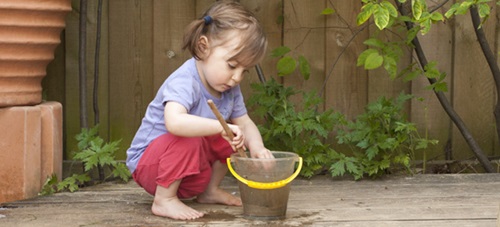
When squirty bottles and simple water tools are made available in easily accessible storage, children are eager to explore water wherever it appears: puddles, drips from rooftops or water leaking through tarps. Rich learning unfolds as they attempt to draw up water, fill containers, and transport it.
Outdoor learning can happen on tarmac or hard surfaces
There’s a common misconception that meaningful outdoor learning can only happen in leafy gardens or forested spaces. While a mix of surfaces is ideal, rich and engaging play can absolutely take place on tarmac or other hard surfaces.
In fact, tarmac offers several advantages. Loose parts play often gravitates towards hard ground because it provides greater stability, particularly for activities like bridge building. Wheeled vehicles, too, are especially enjoyable on tarmac, where the smooth surface allows for a faster, more controlled ride.
Interestingly, mud play can take on a whole new dimension in these environments. By creating small, raised stations, using planks set on logs, tyres or trestles, children can explore soil and water in many focused ways. With just small amounts of soil, containers, and water dispensers, this kind of setup encourages careful, investigative play, often leading to rich mathematical and scientific thinking.

Mixing and painting with soil can happen anywhere. A simple “mud station” invites children to create their own painting mixtures, perhaps adding petals or natural materials, and apply them to large sheets of paper or vinyl attached to a fence.
Water play also works brilliantly on hard surfaces. Using pipes, tubes, crates, buckets, jugs, and funnels, children can build, experiment and problem-solve with ease.
And who doesn’t love to chase or cover their shadows on the tarmac?
Incorporating potted herbs, grasses and flowers can help soften the space and create inviting zones, bringing a touch of nature to even the most urban outdoor area.
Attitude matters
The adult’s attitude plays a pivotal role in shaping how children respond to different weather conditions. If an adult says, “Oh, it’s very wet today. Let’s move under the shelter,” or “Maybe we’ll stay inside where it’s warm,” children will quickly adopt this mindset. But when adults embrace the weather and model curiosity about what it offers, children follow their lead.
During a recent visit to a nursery for three-to four-year-olds where staff fully embrace outdoor learning, it was a joy to watch children explore water in every corner of the play space as rain fell relentlessly. Everyone was appropriately suited and booted. A beautiful outdoor den was available should anyone need a retreat, yet not one child chose to use it during the entire hour-long session.
Be mindful of those needing an extra transition space
Having said all of the above, some children do benefit from a transition space to help them regulate their bodies and minds before fully engaging outdoors. These children may need a few moments in the doorway or under a canopy simply to acclimatise themselves to the change in environment.
Some helpful tips for embracing outdoor play in all weathers
- Create supportive transition spaces: Warm, dry areas for changing and storing outdoor clothing make transitions smoother and encourage independence.
- Allow time for unhurried routines:
Giving children space to change at their own pace reduces stress and supports self-care skills. - Model positive attitudes toward the weather:
Enthusiastic language from adults helps children embrace outdoor learning year-round. - Dress for the outdoors: children and staff!
Accessing the full potential of the outdoor environment requires appropriate clothing and gear for both children and adults. It is vital that everyone feels comfortable outdoors – warm and dry in winter, cool and dry in summer. When children and adults are suitably dressed, they can participate fully and engage in the activities. - Use weather as a learning tool:
Rain, sun, wind, and cold enrich sensory experiences and invite exploration, investigation, and whole-body learning.

Conclusion
Being outdoors with children is not downtime; it is a vital extension of learning where children apply ideas, take ownership of their thinking, and problem-solve with greater freedom. Indoor and outdoor environments work together, each offering unique opportunities that support the whole child, from cognitive growth to emotional wellbeing. So, on with the wellies! A little rain can’t stop the learning.