The sound of learning
How music, movement, and your sound environment shape young minds
| February 2026In the earliest years of life, the senses are a child’s gateway to understanding the world, and sound plays a vital role in that journey. Yet in today’s fast-paced, noisy environments, the importance of sound processing in learning is often overlooked.
We are Sue Newman from Boogie Mites in the UK, and Dr Kathryn Murray from Future Strong Education in Australia. We have been researching the subject of the sound environment, and have produced a course to equip early years educators with the guidance to harness the power of our sound processing system to benefit early brain development. Let's explore some of these concepts together!

The overlooked power of sound in learning
Sound is how we connect, communicate, and make sense of the world. Sound processing is a superpower for brain development. It is at the heart of how we learn, build relationships, and interact with others. So when it comes to designing learning environments, are we truly giving sound the attention it deserves?
Neuroscience evidence shows us that music and movement is a supercharge for the sound processing system, for attention, memory and reward. It also shows that music training helps with discerning speech within a noisy environment, an important benefit when children get to school.In today’s world of constant noise, digital alerts, and endless scrolling, have we lost the ability to truly listen? Are we overlooking one of our most powerful senses – and the critical role it plays in cognitive function for both children and adults? These questions are especially important when we consider how the brain processes sound and why it should be a priority in the early years.
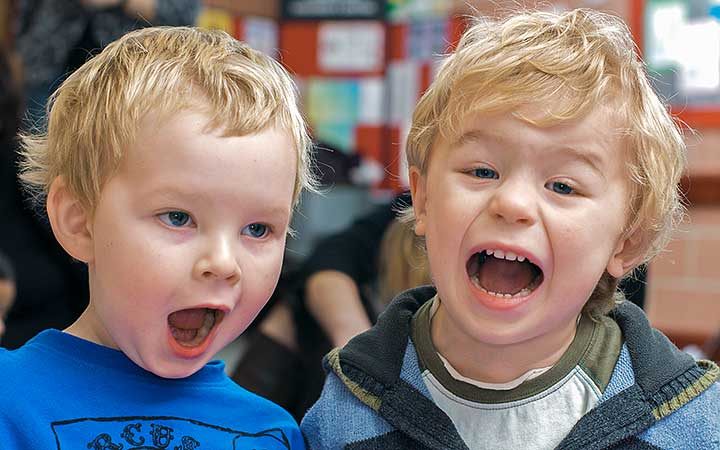
In spoken language, we process 25–30 phoneme sounds every second. If a child’s brain can’t accurately interpret those sounds in the correct order, the meaning gets lost. But when sound processing is functioning well, it allows the brain to clearly recognise and organise these sounds, supporting comprehension, communication, and learning.
The sound processing system
Hearing is the only sense active before birth, and from the moment we enter the world, it begins shaping our brains. The sounds we hear – voices, music, rhythm, and tone – create neural connections that influence how we think, feel, and move. Let us walk you through how this works.
Sound processing begins when sound waves reach the brain through the ear’s vestibular system or via bone conduction. These waves are converted into electrical signals that fuel brain development and impact emotional regulation, attention, and motor coordination. Neuroscience now confirms that music and movement act as a powerful catalyst for this system, enhancing attention, memory, and motivation.
Research also shows that music training helps children distinguish speech in noisy environments, a crucial skill for thriving in busy classrooms. As Dr. Nina Kraus from the Brainvolts Auditory Research Laboratory in the U.S. explains, “The processing of sound drives many of the brain’s core functions – how we think, feel, move, and integrate our senses.”
While we can’t cover the full science here, a dedicated training course delves into the neuroscience of sound and brain development in early childhood. For those interested, we’ve included key references for further reading below.
Planning the learning environment
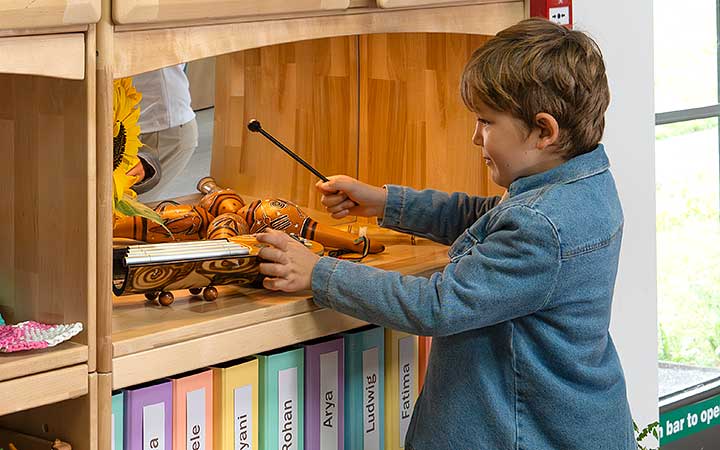
Research shows that sound should be a central consideration when designing early years settings and homes. Large, open spaces with high ceilings and hard materials like concrete, ceramic, or porcelain can amplify noise, creating environments that feel overwhelming and unsettling for young children. These acoustically harsh spaces are far from ideal for learning and development.
The good news is that improving the sound environment doesn’t have to be complicated. Small, thoughtful changes can significantly support children's ability to process sound, focus, and thrive.
Consider:
- Having a range of learning spaces and soft furnishings to create a good sound learning environment.
- Having a little space between pieces of furniture to break the sound wave.
- Incorporating partitions, such as screens or bookshelves, as space dividers to disrupt the sound waves.
- Providing clusters of plants around the learning spaces, as plants have powerful noise reduction capabilities.
- Noise-absorbent flooring – wooden floors, carpets and rugs help to reduce noise.
- Wooden shutters or sound absorbent curtains at windows are particularly important if near a busy road.
- Sound absorbent ceilings, such as ceiling tiles, can help reduce bouncing sound.
- Attaching traditional floor rugs to the walls to absorb sound can look attractive and be practical too.
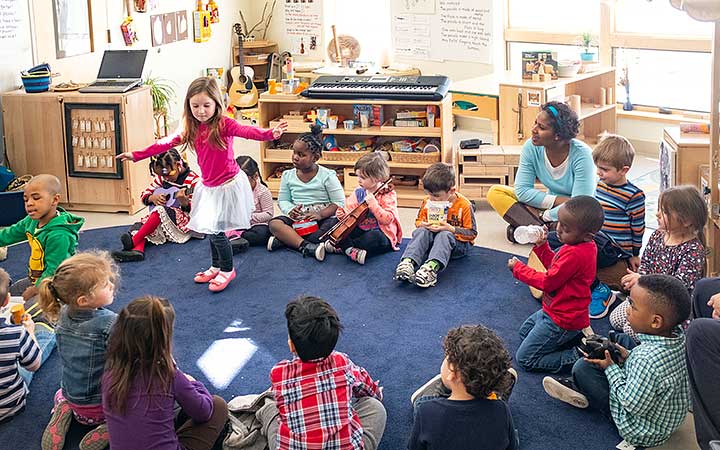
We recommend designing defined learning areas with both sound and skill development in mind. When children feel safe and secure, their brains are better able to focus and learn. Small, thoughtfully arranged spaces promote concentration and confidence, while larger areas are ideal for group music experiences like singing, dancing, and movement.
Having an educator guide these musical activities further enhances that sense of safety, helping to calm and focus young minds. It’s also important to offer quiet spaces or moments of stillness, where children can tune in to the sounds around them, or create their own. These quiet moments not only support emotional regulation but also expand language as children learn to describe what they hear.
Equipping educators
Firstly, as educators, we need to understand the sound–brain partnership, the value of the sound environment, and the role that daily sound experiences – alongside group music and movement activities – play in brain development.
Secondly, we need to build musical confidence and develop the skills and resources to notice and play with sounds, enabling us to facilitate music activities every day. It is important to dispel the myth that musical ability is something you are either born with or not. We need to understand that we can all improve our melodic and rhythmic awareness through daily practice, alongside the children, and that this process can also support our own mental and physical health. Educators also need to understand what a wide and varied sound and music provision looks like in order to create the best possible environment for strengthening the sound processing system.
Boogie Mites Music Programmes, underpinned by the ABCD Music Methodology, have been compiled specifically for educators who are not musicians. These programmes equip educators with the training and resources needed to make a wide range of music activities part of everyday practice within the setting.
Once educators are confident in their understanding of sound and in initiating music activities, they are better able to support children in developing this same confidence. Educators can encourage children to process sounds, discuss how they make us feel, what we liked or didn’t like, how different objects can be used to create sound, and how we can move in response to sound. These conversations can be facilitated by the teacher in both small, well-curated, sound-friendly spaces and in larger group music and movement meeting spaces.
In conclusion
Educators don’t need to be musicians, but all educators can guide children in exploring sound – talking about how it feels, experimenting with materials, and moving with music. Whether in small listening corners or larger music areas, a rich sound environment helps build essential processing skills for lifelong learning.
References to studies and further reading:
You can find out more about the sound environment course here:
Sound Environment Matters Masterclass with Dr Kathryn Murray & Sue Newman (earlyyears.tv)
Boogie Mites and Future Strong Education advocate sharing education about the importance of the sound environment with parents. This can be done via a music parent-education workshop. The course also includes top environment tips for the classroom or home from Dr. Murray and access to Boogie Mites videos, songs and music activities to trial with your children, in a calm space. You can observe their brains processing the sounds as they take part. You will be amazed to find out just how much the sound environment matters!
L Ferreri, E Mas-Herrero, A Rodriguez Fernells “Dopamine modulates the reward experiences elicited by music” (2019).
Murray, K. (2022). A calm brain is a thinking brain using the Brain-SET Formula for classroom design. The Space. New Zealand, September.
Murray, K. (2021). The Brain-SET Formula for Classroom Design: Designing the classroom with the brain in mind. Childspace Magazine, September issue.
Music is the Jackpot – Nina Kraus: https://www.youtube.com/watch?v=SzDjn7XDbcQ.
Of Sound Mind: Brainvolts Laboratory.
Rhythmic awareness helps hearing speech in noise: Slater J, Kraus N, Woodruff Carr K, Tierney A, Azem A, Ashley R (2018) Speech-in-noise perception is linked to rhythm production skills in adult percussionists and non-musicians. Language, Cognition and Neuroscience. 33(6):710-717.
SB Nutley, F Darki, T Kingberg “Music practice is associated with development of working memory during childhood and adolescence” (2014).
Tierney, A.T., TR Bergosen-Dana, T.R., Bisoni, D. (2007).“ Effects of early musical experience on auditory sequence memory.”