Little kitchens, big conversations
How the Kitchen Island supports pedagogy through imaginative role play.
| May 2026Language underpins children’s learning, relationships, and future life chances (Clegg and Ginsborg, 2006). In the early years, thoughtfully designed role play environments can powerfully support communication and wider development. But what happens when design and pedagogy truly work together? Community Playthings’ Kitchen Island was created in response to this question – translating research on play, language, and child development into a collaborative space for learning and growth.
The Kitchen Island and the pedagogy of play
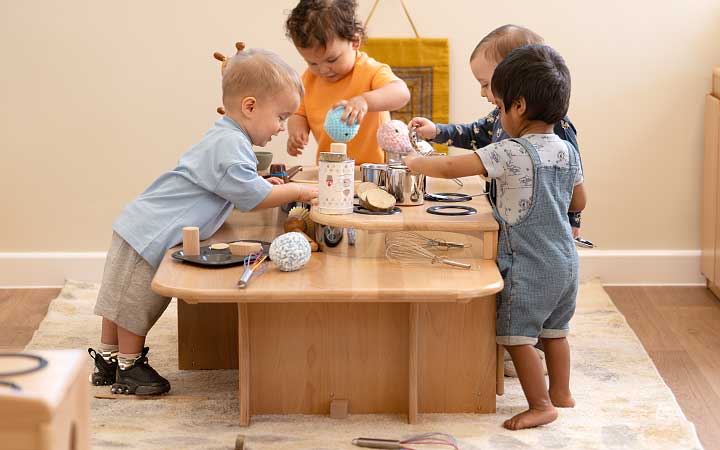
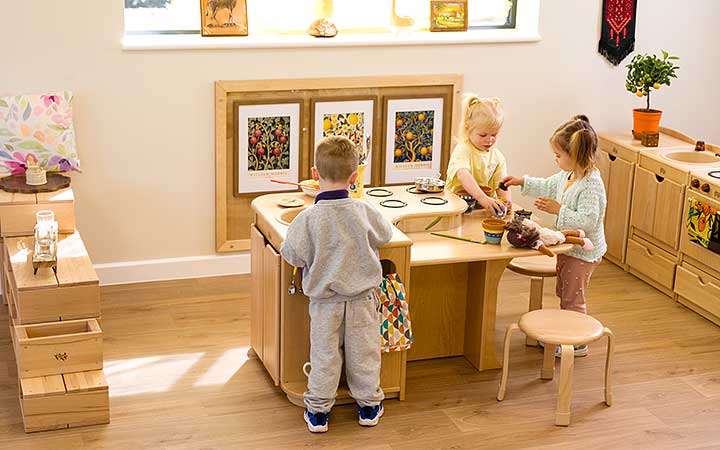
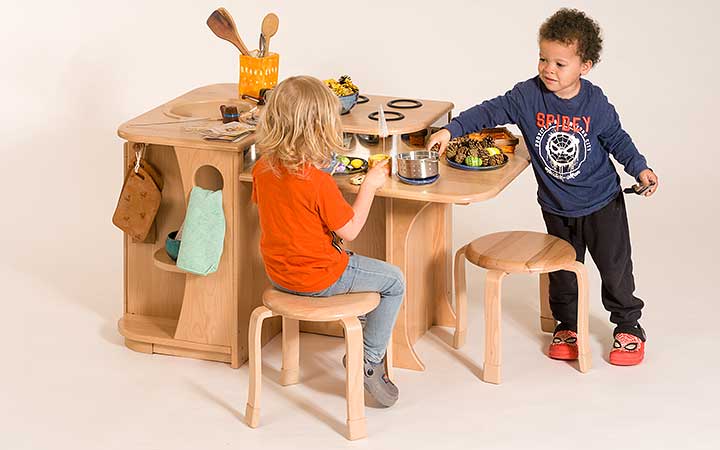
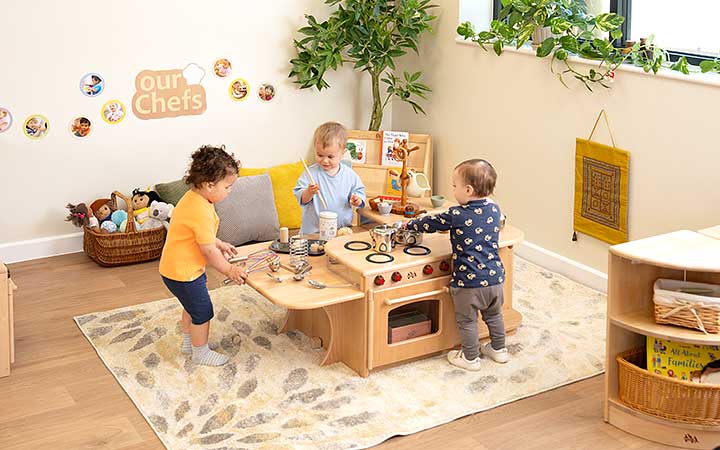
The Kitchen Island was developed through close observation of how children learn through role play, with research into children’s social development informing a design that intentionally supports communication, literacy, and collaboration within the zone of proximal development (Vygotsky, 1978). Its open, accessible form encourages face-to-face interaction, shared attention, and the natural exchange of language; additionally, proportions informed by children’s physical capabilities support cooperative use of materials. Split-level surfaces allow children at different stages of play to engage alongside one another, gently encouraging collaboration, while open-ended features support symbolic play, storytelling, and early literacy. Exploring the pedagogy behind the Kitchen Island reveals how thoughtful design can translate research on play and language into meaningful learning experiences.
Language as the foundation for learning
The design of the Kitchen Island is grounded in a clear pedagogical principle: the ability to communicate and use language is central to lifelong development (Mulcair et al., 2018). Children’s life chances are strongly shaped in the first five years, with later outcomes closely linked to early language development (Field, 2010). While much learning happens at home, early years settings play a vital role in creating language-rich environments.
The role play area is one such space. Through teamwork and shared attention, it draws children into the zone of proximal development, supporting language, self-regulation, confidence, and essential life skills through collaborative play (Vygotsky, 1978). The Kitchen Island is intentionally designed to support this process – inviting children to gather, communicate, and negotiate over an imaginary meal of steak, salad and chips.
The first steps into literacy
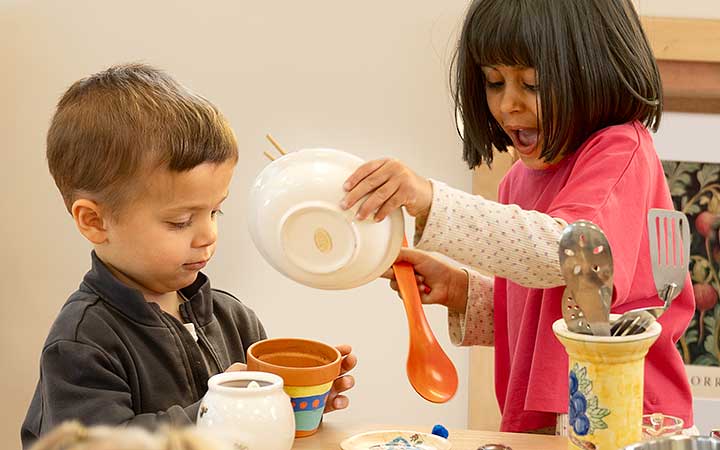
Within language-rich role play environments, literacy development emerges naturally through imaginative engagement. When a child picks up a wooden block and serves it on a plate, it becomes a Sunday roast. This ability for one object to stand for another – known as symbolic representation – marks a child’s earliest foothold in literacy. If a block can represent a meal, then a letter can represent a sound (Piaget, 1962).
As children create storylines and narratives around shared play experiences, they extend their vocabulary and deepen their understanding of words and meaning, often without realising they are doing so. This lays a crucial foundation for later reading and writing skills.
Strengthening communication and language through play
Role play is also central to the development of communication and language. Taking on a role requires children to adopt another perspective, using the language and behaviours of their chosen character. Within this meaningful context, children create storylines and experiment with new words and phrases, using them with increasing confidence.
Through collaborative play, both receptive and expressive vocabulary are shared and gradually internalised. Environments that encourage face-to-face interaction naturally support this process by making communication visible, social, and purposeful. Who will speak first? Who will listen? And how will the story unfold?
Self-regulation and role play
Building on communication skills, collaborative role play also strengthens self-regulation. In shared scenarios, such as playing a young chef, children must coordinate plans, sustain a narrative, agree on rules, and solve problems through dialogue. Role play nurtures less visible skills such as shared attention, impulse control, and role-taking, which emerge most strongly in socially rich play (Bredikyte and Brandisauskiene, 2023).
As self-regulation is a key predictor of academic success, thoughtfully planned role play environments can provide an ideal setting for developing these skills – one recipe at a time.
Social and emotional development: Learning with and from others
Alongside self-regulation, role play makes a significant contribution to children’s social and emotional development. Sustained pretend play is strongly linked to higher levels of empathy, as children learn to understand and respond to others’ emotions through perspective-taking (Brown et al., 2017).
The Education Endowment Foundation (EEF, 2025) highlights the importance of self-regulated learning and metacognition in the early years. When adults use language of possibility, they support children to plan, problem-solve, and reflect together within shared play; this deepens both emotional understanding and collaborative thinking. What might happen next? What could we try differently?
Conclusion
When carefully planned, role play spaces become rich learning environments that nurture language, self-regulation, and social development. It’s time to turn pedagogy into practice, and to create a space for children where conversation flows and stories unfold. After all, some of the most meaningful learning begins with a shared idea, an intentional environment, and the question: “What shall we play today?”
References
Bredikyte, M. and Brandisauskiene, A. (2023) ‘Pretend play as the space for development of self-regulation: cultural-historical perspective’, Frontiers in Psychology, 14, 1186512. Available at: https://doi.org/10.3389/fpsyg.2023.1186512.
Brown, M.M., Thibodeau, R.B., Pierucci, J.M. & Gilpin, A.T. (2017) ‘Supporting the development of empathy: The role of theory of mind and fantasy orientation’, Social Development, 26(4), pp. 951–964.
Clegg, J. and Ginsborg, J. (eds.) (2006) Language and social disadvantage: theory into practice. Chichester: John Wiley & Sons Ltd.
Education Endowment Foundation (EEF). (2018) Metacognition and self-regulated learning: Guidance report. London: Education Endowment Foundation. (Accessed: 1 December 2025).
Field F. (2010) The foundation years: Preventing poor children becoming poor adults. The report of the independent review on poverty and life chances.
Mulcair, G., Pietranton, A. A., & Williams, C. (2018). The International Communication Project: Raising global awareness of communication as a human right. International Journal of Speech-Language Pathology, 20(1), 34–38.
Piaget, J. (1962) Play, dreams and imitation in childhood. New York: W.W. Norton.
Vygotsky, L.S. (1978) Mind in society: The development of higher psychological processes. Cambridge, MA: Harvard University Press.
Further reading
Parten, M. B. (1932). Social participation among pre-school children. The Journal of Abnormal and Social Psychology, 27(3), 243–269.
Public Health England (2020) Best start in speech, language and communication: Supporting evidence. London: Public Health England.
Siraj-Blatchford, I. (2009) ‘Conceptualising progression in the pedagogy of play and sustained shared thinking in early childhood education: a Vygotskian perspective’, Educational and Child Psychology, 26(2), pp. 77–89.