Creating powerful learning spaces
How the early years environment shapes young minds
| March 2026In the early years, the environment is not merely a backdrop to learning but an active part of it. The physical and sensory characteristics of nurseries and classrooms shape what children can attend to, how much effort they must expend to hear and understand language, and whether their nervous systems can remain sufficiently regulated for play, learning, and social interaction. This is particularly important because executive function skills – such as working memory, inhibitory control, and cognitive flexibility – develop between birth and age five, and are especially sensitive to stress, distraction, and cognitive load (Blair & Raver, 2016).
At ISEY, Institute for the Science of Early Years, our research focuses on how early environments influence children’s development. We are interested in how early environments can be designed to better support learning, wellbeing, and development, particularly for children who are disadvantaged.

Attention, cognitive load, and the cost of coping
Young children’s attention is strongly drawn to noise, movement, and colour. As we explain in our book Take Action on Distraction (Wass and Goldenberg, 2025), these features automatically capture attention for evolutionary reasons, and young children find this instinctive response difficult to override. In busy environments, the brain has to continuously filter competing inputs: overlapping voices, movement, bright displays, reverberant sound. That filtering process doesn’t come for free; rather, it draws on the same limited cognitive resources that children need for language processing, problem-solving and self-regulation. This contributes to cognitive overload and can affect children’s learning and capacity to regulate.
Experimental research on ‘visual noise’ in the classroom illustrates this clearly. Fisher, Godwin, and Seltman (2014) manipulated wall displays in an early years classroom and found that, compared with a more visually streamlined environment, children in a highly decorated classroom were more distracted, spent more time off-task, and learned less. The implication of this is not that walls should be completely bare, but that we should be purposeful and intentional about the visual materials we surround children with. When everything competes for attention, attention is harder to sustain.
Auditory noise places a similar load on young learners. High background noise and fluctuating sound levels reduce speech intelligibility and increase listening effort, leaving fewer resources available for comprehension and engagement. Studies have linked both average noise level and noise variability to lower child wellbeing and poorer learning outcomes (Wass and Goldenberg, 2025; Linting et al., 2013; Werner et al., 2015).
Noise, acoustics, and early language development
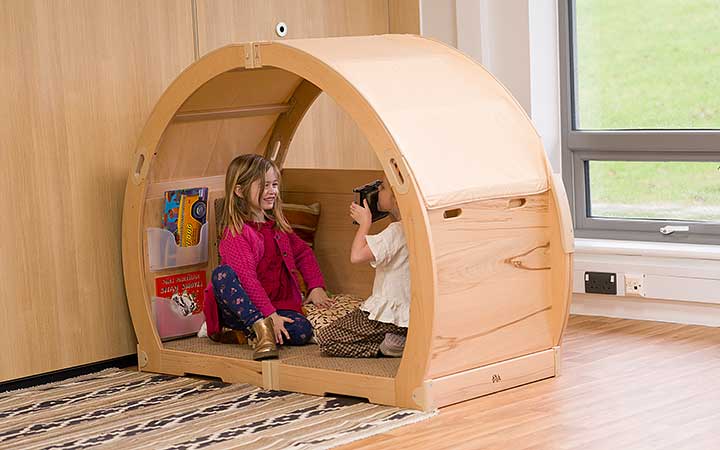
Reverberation – when noises bounce off hard surfaces in a room – and background noise blur speech sounds, making it more difficult to discriminate phonemes, follow instructions, and participate in turn-taking. To explore this in greater detail, ISEY has just begun a three-year project, funded by Nuffield, examining how noise in early years settings affects children’s speech and language development.
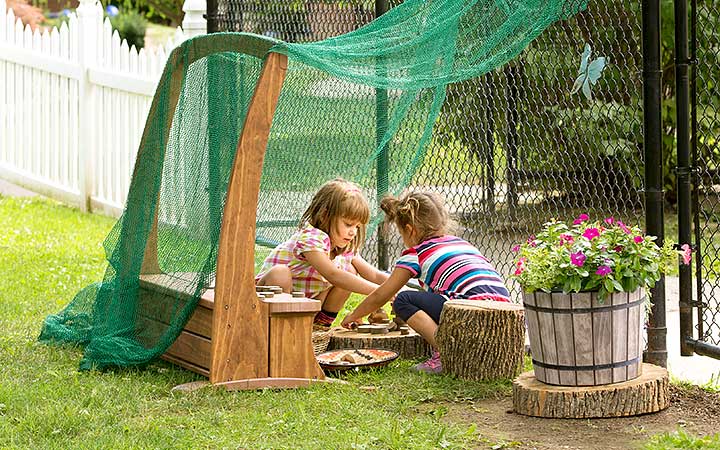
Spending time outdoors can help reduce noise. Our own research shows that when four- and five-year-old children engage in the same activities both indoors and outdoors, outdoor sessions are significantly quieter and children’s stress levels are lower (Goldenberg et al., 2024). For some children – especially those who struggle with attention and self-regulation indoors – attention and behaviour are also much improved outdoors (Atkinson et al., 2025).
Your classroom design shapes learning trajectories
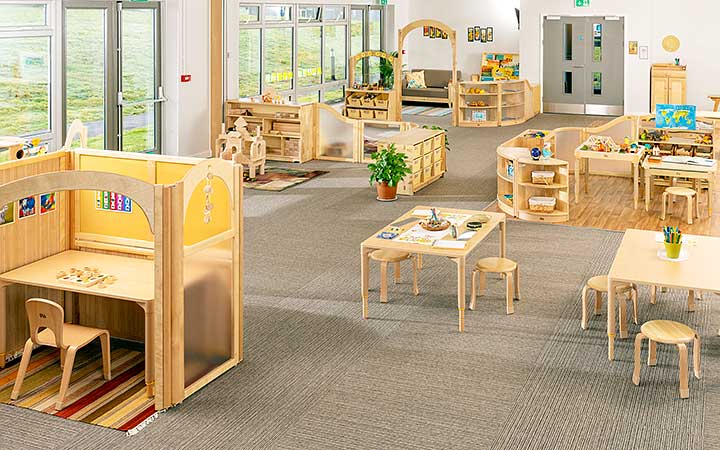
The organisation of space shapes children’s behaviour by influencing how often they are interrupted or uncertain about what to do next. Clear pathways, defined activity zones, and consistent, accessible storage reduce the constant low-level decision-making associated with questions such as “Where do I go?”, “What happens here?”, and “Who is in my space?”. This predictability supports the development of executive function by lowering demands on working memory and inhibitory control (Blair & Raver, 2016).
Evidence from wider school design research supports the idea that physical classroom features can meaningfully influence learning outcomes. A UK-based study found that classroom design characteristics accounted for around 16% of the variation in pupils’ learning progress over a year (Barrett et al., 2015). The most effective spaces were characterised by good natural light, air quality, thermal comfort, and appropriate acoustics. The study also found that effective classrooms had clear zones, flexible furniture layouts, and spaces that supported choice and movement. Levels of stimulation were important too: classrooms associated with the strongest learning outcomes were neither bare nor overwhelming. Medium levels of colour and visual complexity worked best. Taken together, this research reinforces the idea that the environment can actively contribute to learning trajectories rather than simply serving as the place where learning happens.
Utilising natural colours and materials may also help reduce processing demands and support learning and wellbeing. Research suggests that placing plants in the room improves both children’s cognition and their wellbeing (Bernardo et al, 2021; Han, 2009; Van Den Berg et al, 2017) whilst better emotional states (including lower anxiety and higher comfort) have been reported in children from classrooms with wooden interiors (Sakaguchi et al, 2025).
The role of co-regulation spaces
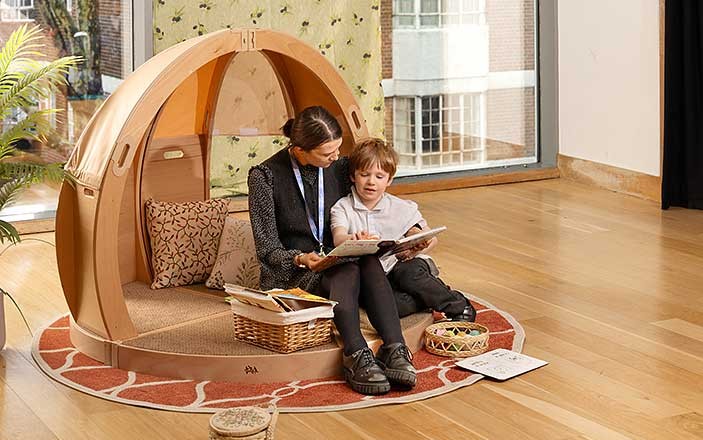
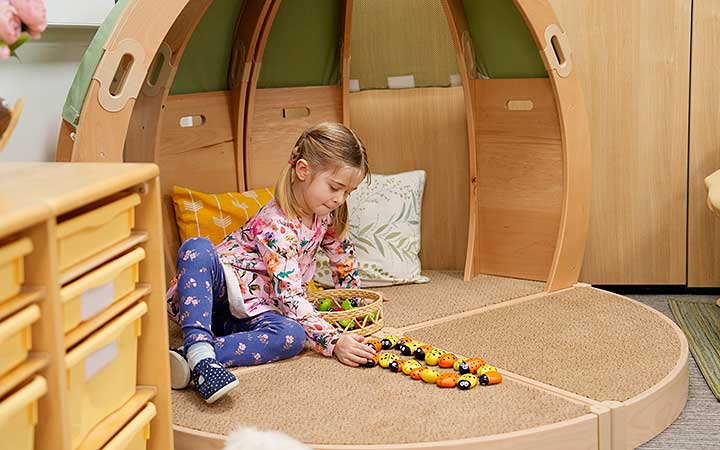
It is also important to recognise that one single environment will never be optimal for all children; one way that we can manage this challenge is to provide safe spaces where children can regulate when the situation feels 'too much'. In the early years, children don't yet have the capacity to consistently self-regulate; regulation is learned through repeated experiences of co-regulation with an attuned, responsive adult. Low-stimulus spaces that comfortably accommodate both child and adult support this process by allowing adults to sit alongside children, attune to their emotional state, and model regulated responses.
When environments make co-regulation easy and predicable – by reducing sensory load and providing clearly defined, semi-enclosed spaces that feel safe rather than restrictive – children are better able to return to a regulated state. Over time, they also internalise these regulatory strategies for themselves.
Practical design principles for early years settings
Across the research, several consistent principles emerge:
- Reduce visual noise: Keep displays intentional and rotate rather than accumulate materials. Limit the use of complex patterns and multiple competing colour schemes.
- Design for predictability: Clear zones, uncluttered routes and cohesive designs reduce cognitive load. Cohesion involves having clarity and consistency in the environment.
- Improve acoustics: Reduce reverberation where possible by introducing more soft materials, dampen unwanted noise sources (such as scraping chair legs), and separate loud and quiet activities.
- Build in retreat and co-regulation: Provide predictable low-stimulus spaces and teach children how and when to use them. Quiet, enclosed spaces that children can retreat to helps them cope with high levels of both auditory and visual noise, and supports self-regulation.
A well-designed early years environment is not about perfection or trendy aesthetics; it is about removing avoidable burdens on attention and regulation so that children’s developing brains can do what they are primed to do: explore, communicate, connect, and learn.
References
Atkinson, M., Goldenberg, G., Dubiel, J., & Wass, S. (2025). Differential Effects Of An Urban Outdoor Environment On 4-5 Year Old Children’s Attention In School. Journal of Environmental Psychology, 102589.
Barrett, P., Davies, F., Zhang, Y., & Barrett, L. (2015). The impact of classroom design on pupils’ learning: Final results of a holistic, multi-level analysis. Building and Environment, 89, 118–133. https://doi.org/10.1016/j.buildenv.2015.02.013
Bernardo, F., Loupa-Ramos, I., Matos Silva, C., & Manso, M. (2021). The restorative effect of the presence of greenery on the classroom in children’s cognitive performance. Sustainability, 13(6), 3488.
Blair, C., & Raver, C. C. (2016). Poverty, stress, and brain development: New directions for prevention and intervention. Current Opinion in Behavioral Sciences, 10, 102–107. https://doi.org/10.1016/j.cobeha.2016.05.010
Fisher, A. V., Godwin, K. E., & Seltman, H. (2014). Visual environment, attention allocation, and learning in young children: When too much of a good thing may be bad. Psychological Science, 25(7), 1362–1370. https://doi.org/10.1177/0956797614533801
Goldenberg, G., Atkinson, M., Dubiel, J., & Wass, S. (2024). Outdoor learning in urban schools: Effects on 4–5 year old children's noise and physiological stress. Journal of Environmental Psychology, 97, 102362.
Han, K.-T. (2009). Influence of limitedly visible leafy indoor plants on the psychology, behavior, and health of students at a junior high school in Taiwan. Environment and Behavior, 41(5), 658–692.
Linting, M., Groeneveld, M. G., Vermeer, H. J., & van IJzendoorn, M. H. (2013). Threshold for noise in daycare: Noise level and noise variability are associated with child wellbeing in home-based childcare. Early Childhood Research Quarterly, 28(4), 960–971. https://doi.org/10.1016/j.ecresq.2013.03.005
Sakaguchi, H., & Tsunetsugu, Y. (2025). Investigation of the environmental conditions at a junior high school with wooden and non-wooden interior wings I: the effects of wooden classroom interiors on the indoor environment and the psychological and physiological states of junior high school students. Journal of Wood Science, 71, article 31
Van den Berg, A. E., Wesselius, J. E., Maas, J., & Tanja-Dijkstra, K. (2017). Green walls for a restorative classroom environment: A controlled evaluation study. Environment and Behavior, 49(7), 791–813.
Wass, S., & Goldenberg, G. (2025). Take Action on Distraction: The definitive guide to improving attention and focus in the Early Years and Key Stage One. Bloomsbury Publishing.
Werner, C. D., Linting, M., Vermeer, H. J., & van IJzendoorn, M. H. (2015). Noise in center-based child care: Associations with quality of care and child emotional wellbeing. Journal of Environmental Psychology, 42, 190–201. https://doi.org/10.1016/j.jenvp.2015.05.003