Boy watching digger

    Cherry tree or JCB?

    Childhood has its own way of seeing, thinking and feeling, and nothing is more foolish than to try to substitute ours for theirs. Rousseau

    A few days ago my neighbour was walking with her young son. In the middle of a roundabout stood a cherry tree at the height of its springtime glory. Suddenly the child came to a standstill, saying in awe, ‘O Mummy, look!’ She responded, ‘Isn’t it wonderful?’ The child breathed, ‘It’s a JCB!’

    Mother and child had eyes for entirely different things!

    Did you know that tomorrow, 15 May, is National Children’s Day? Join in with these child-led activities.

    Through the eyes of a child

    Through the eyes of a child

    A few weeks ago tree surgeons removed a dying tree adjacent to my two-year-old son’s nursery. Since then, every odd-shaped piece of wood he finds is his chainsaw. He has a whole collection of chainsaws under his bed. It makes housekeeping interesting – but that’s OK. When we pass a construction site on the way home from nursery, he’s the one driving the digger or the dumper. If imagination is a trait of early childhood that you feel is important, then we have something that you will love!

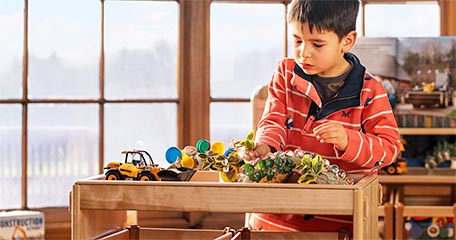
    Through the eyes of a child explores the brand-new Community Playthings PlayFrame through the stories of five children. We see an event in their lives captured in stunning black and white photography while colourful illustrations give us a glimpse into the child’s thoughts. Then we find out how they re-live that experience on the PlayFrame. The result is a delightful picture book which your children may enjoy as much as you do!

    Click here to request a free copy of Through the eyes of a child

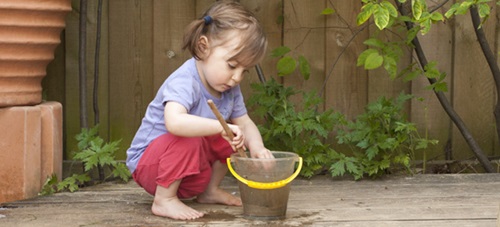
    Sand and water play

    Why children should play in school

    John Coe, chairman of National Association for Primary Education, recently described a visit he’d just made to a school. Two 11-year-olds had been assigned to tour him round the building. Approaching the Reception classroom the children became visibly eager, hurrying their pace. On entering, they made a beeline for the Sand and Water table where they showed John all they could achieve with hosepipes and pulleys – talking excitedly all the while.

    John told me, “The children were intelligent Year 6 pupils. Their spontaneous move to play like four-year-olds is a powerful indication of the denial of the inclination to play (and learn) which is characteristic of too many test-driven schools.”

    Motivation levels are high during play. Remember Vygotsky’s words about a child at play being “a head taller than himself.” Schools would do well to include play as a natural part of their curriculum. The learning potential is tremendous.

    Click here to download Play and the revised EYFS, our guide to how children’s play naturally fulfils the revised EYFS.
View more

Search or browse for another Blog